The Gym Floor: Etiquette Nobody Tells You, in the Order You'll Need It
Gym etiquette for beginners, in the order you meet it: the machine you want is taken, the wipe-down, putting things back, and what counts as staring.
Most gym etiquette for beginners is written as a list of commandments, which is the wrong shape for it. You do not meet these rules as a list. You meet them one at a time, in a fairly predictable order, each at the moment you are least prepared to think about it — and what you need is not the rule but the sentence that goes with it.
So this is in the order you will actually hit them, from the first thirty seconds on the floor to the way out. There are five that genuinely matter and a great many that do not, and the main thing to understand up front is that the real code is much shorter and much more forgiving than it looks from the doorway.
The whole of it, compressed: leave things as you found them, do not stand in anybody’s way, and do not make anybody wait longer than they have to. Everything below is a consequence of those three.
1. The machine you want is taken
This is the first one you meet, usually within a minute, and it is the one that sends beginners home.
You have decided on a machine. Somebody is on it. There is no system, no queue, and no obvious way to find out how long they will be. The instinct is to wander, then wander again, then leave.
What people actually do: ask. The sentence is “how many sets have you got left?” or, more simply, “are you nearly done?” It is asked constantly, it is not rude, and the answer is a number. If the answer is “three more,” you go and do something else for six or seven minutes and come back.
The other move, and the better one on a first visit: have a second choice. If the bike is taken, the cross-trainer does the same job. If the leg press is taken, there is almost always a second one, or a machine two along with a diagram that works the same thing. Being attached to one specific machine is a luxury of people who have a programme, and you do not have one yet.
What is not etiquette: hovering two feet away to signal that you are waiting. It is the one thing in this whole article that genuinely annoys people. Stand a reasonable distance back, or ask, or go elsewhere.
2. Someone asks to “work in” with you
The reverse of the above, and it will happen to you eventually — usually at a bench or a machine, usually phrased as “mind if I work in?”
It means: while you are resting between sets, they do a set of theirs, and you alternate. The answer is yes, and the practical version is that you do your set, step back, they do theirs, you go again. If they are using a very different weight and it is a plate-loaded machine, it is fine to say “sure, but I’ll need to change the pin each time” — nobody minds, and often they will offer to go elsewhere.
On a first visit, you can also simply say “I’m nearly finished, two minutes.” That is true and complete.
3. The wipe-down
The one piece of etiquette that is genuinely universal, in every gym, in every country, with no exceptions and no local variation.
If your skin touched it, you wipe it. Benches, the back pad and seat of a machine, the handles of anything you gripped hard. There will be paper towel and a spray bottle on the wall, or a dispenser of wipes, usually in two or three places around the floor. Find them in your first minute on the floor so you are not looking for them later.
This takes about four seconds and it is the single cheapest way to read as someone who belongs there. It is also the reason to carry a small towel: on a bench, laying a towel down is the wipe-down done in advance.
4. Putting things back
Second-most universal, and the one with a visible failure mode.
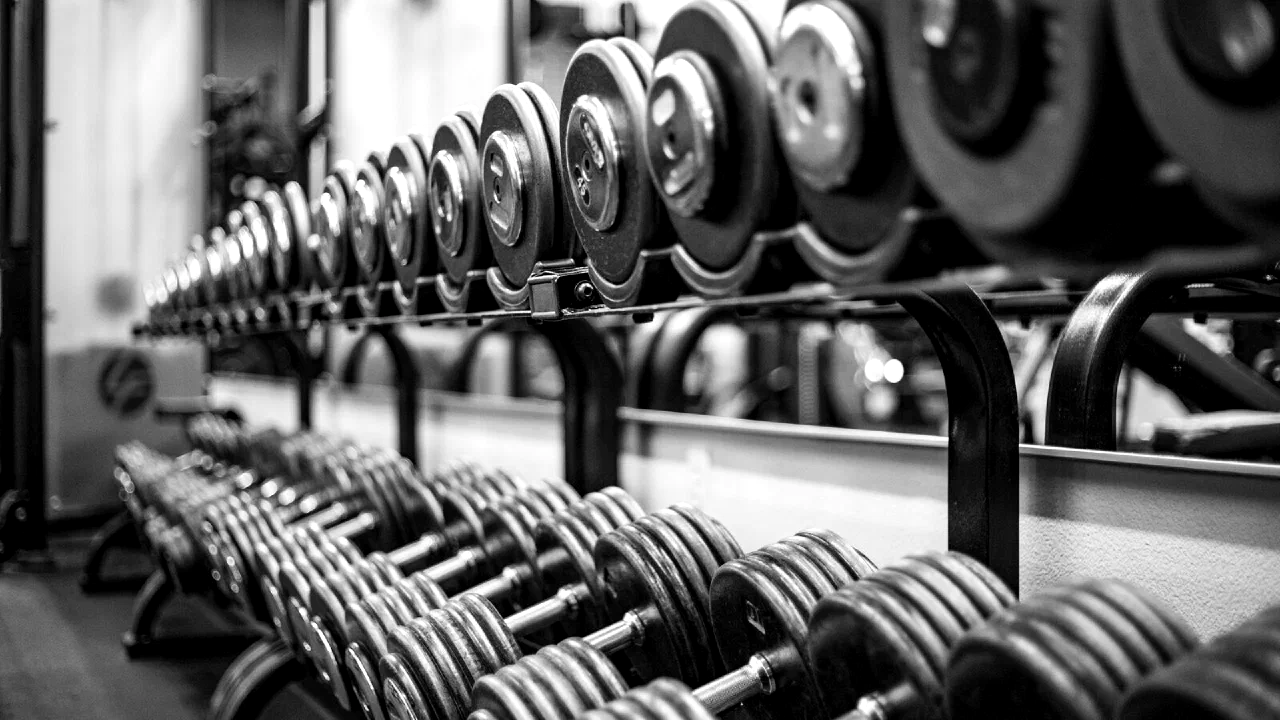
Dumbbells go back on the rack, in the right slot, matching the number. Plates come off the bar and go back on the tree, grouped by size. Pins, benches and attachments go back where you found them.
The reason this matters more than it seems: a plate left on a bar means the next person has to unload it before they can use it, and an unracked dumbbell means somebody has to search the floor for its pair. It is the “do not make anybody wait” rule in physical form.
If you cannot work out where something goes, the slot is nearly always labelled, and if it is not, leaving it tidily near the rack is better than leaving it where you were standing. Nobody will say anything either way. But this is the one people notice.
5. Where to stand, and the mirrors
Two spatial rules that are invisible until you break them.
Do not stand directly in front of somebody who is mid-set, especially in the free-weight area, and especially between them and a mirror. The mirror is not vanity; it is how people check what they are doing. Walking through that line is the gym equivalent of standing in front of a television.
Do not set up immediately in front of the dumbbell rack. It blocks access for everybody else. Take the weights you want and move a couple of steps back.
Neither of these will get you spoken to. Both are worth knowing because they are the difference between feeling out of place and being slightly in the way, which are easy to confuse when you are new.
The ones you are worried about that are not rules
Half of what beginners brace for is not etiquette at all.
| What you are worried about | What is actually true |
|---|---|
| Using the “wrong” machine for your level | There is no level system. Machines are not allocated |
| Being on a treadmill for only ten minutes | Entirely normal. Nobody tracks durations |
| Lifting a light weight | The racks start light for a reason. Nobody is reading the number |
| Resting for two minutes between sets | That is what resting between sets is |
| Not knowing what you are doing | Visible, and conveys nothing anyone can use |
| Being the only person in your clothes | Gym clothing is whatever you can move in |
| Taking a photo in the changing room | This one is a rule. Never, anywhere, no exceptions |
That last row is the only hard prohibition in the building, and it is about other people’s privacy rather than etiquette.
Phones, headphones and talking
Headphones are the default and they are a social tool. Headphones in means you are not available for conversation, and that is read and respected. On a first visit, wear them whether or not you are listening to anything.
Phones are completely normal — people use them for timers, for the gym’s own app, for the programme they are following, and for scrolling between sets. The only version that bothers anybody is sitting on a machine somebody is waiting for while scrolling, which is the “do not make anybody wait” rule again.
Nobody will talk to you, and that surprises people. A gym floor is not a sociable room. If you want the version where people do talk to you, that is a class or a club, and it is a different kind of first session entirely.
Staff are the exception: floor staff will sometimes ask if you are getting on all right. The honest answer is fine, and “actually, how does this one work?” is the best fifteen seconds you can spend on a first visit.
What counts as staring
Almost nothing, and this is worth stating because it is the fear underneath the whole subject.
Eyes move around a gym constantly. People look up between sets, they check the clock, they glance at the door when it opens, they look in the direction of a noise. Being in somebody’s field of view for two seconds is not being watched, and the reason it feels like it is that you are the only person in the room who is self-conscious enough to be counting.
The actual test is duration and repetition, and if someone genuinely is staring repeatedly, or says something, that is not etiquette — that is a staff conversation, and every gym has a procedure for it. Raise it at the desk. You are a paying member and that is what the desk is for.
For most people, though, the feeling fades on its own: strongest on visit one, noticeably weaker on visit two, mostly gone by about the fourth. If it is not fading, it is worth reading the version of this that is about feeling out of place rather than treating it as a rule you are breaking.
Gym etiquette for beginners: the whole code, on one line
Wipe what you sat on. Put back what you took out. Do not stand in front of people. Ask how many sets are left instead of hovering. Do not photograph anybody.
That is it. Five things, four seconds each, and none of them is about competence. Everything else you are worried about on a first visit is a feeling rather than a rule, and the difference is worth knowing before you walk in — because the rules you can follow from minute one, and the feeling you cannot do anything about except go back.